ARJA HOP
Dit is een paragraaf. Klik hier om je eigen tekst toe te voegen.
VOLCANIC MATTER
Painting and drawing research, 2010–2013 / ongoing research
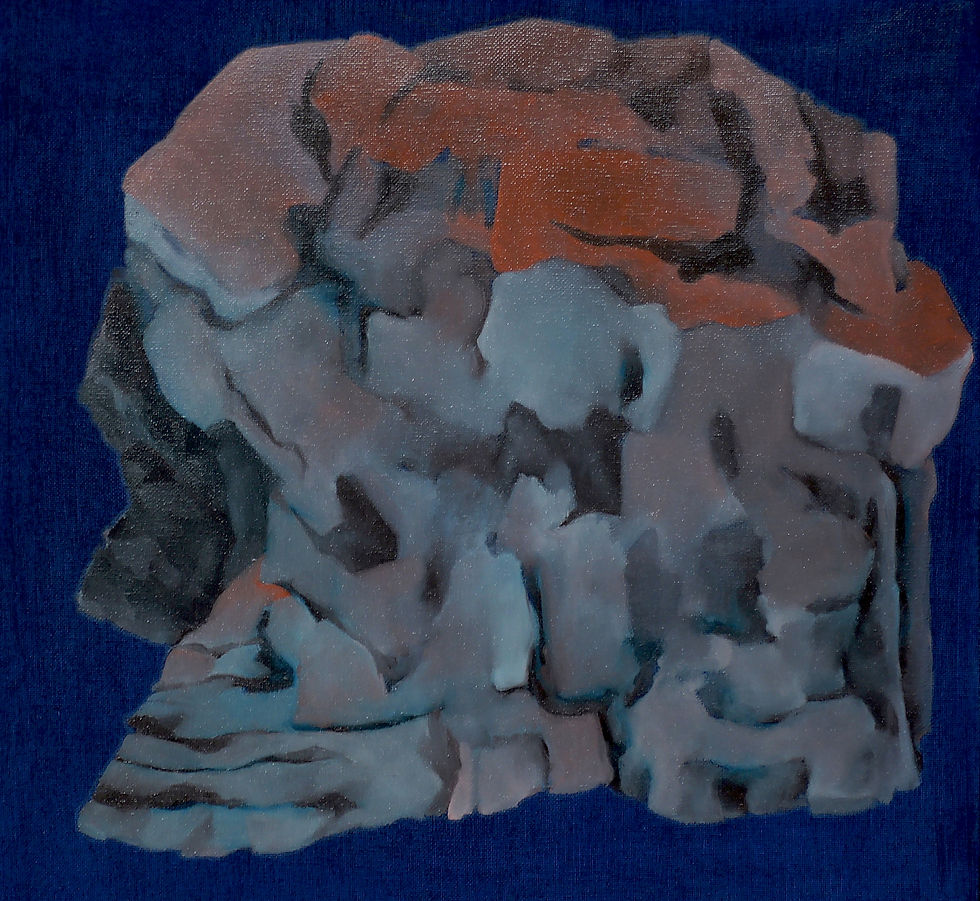
Between 2010 and 2013, I developed a body of paintings and drawings investigating different manifestations and structures of volcanic rock. The research originated partly from periods I spent in Sicily, where I frequently explored the volcanic landscape surrounding Mount Etna. Observing differences in colour, density, porosity, surface, fracture and structure at close range led to an investigation into matter and transformation.
The paintings range from 40 × 40 cm to monumental canvases measuring 2 × 2 metres. I stretched and prepared the linen myself and made my own oil paint using existing pigments mixed with oil. The preparation of both support and paint therefore formed part of the material process of the work.
Volcanic rock is formed as magma or lava cools and solidifies. Chemical composition, temperature, pressure, cooling rate and the presence of gases contribute to radically different material structures. Rapid cooling can limit crystal formation and produce glass-like structures, while other conditions allow crystalline or highly porous forms to emerge. Volcanic rock can therefore be understood as a material record of the processes and conditions through which it was formed.
The recognisable form of volcanic rock provided a point of departure, rather than an image to be reproduced precisely. Within and through this form, I investigated differences in density, porosity, surface, fracture, colour and scale. Dense and amorphous forms exist alongside porous and open structures; smooth areas contrast with cavities, layers and concentrations of matter. Colour could become independent of the external appearance of a particular rock, creating a painterly reality in which transparency, density and surface continuously interact.
Painting and drawing offered different ways of approaching the same material. While the paintings allowed me to investigate mass, colour, surface and density, drawing brought greater attention to internal structure, fracture, layering and the organisation of form. The drawings function as a parallel mode of investigation rather than as preparatory studies for the paintings.
Scale further changes the perception of these forms. On the smaller canvases they can still be perceived as individual objects, while at two by two metres they become almost environmental. Their structures can evoke both microscopic and geological scales without settling into a single, fixed representation.




From rock to pigment
A possible continuation of this research shifts the relationship between subject and material. Whereas I originally made my oil paint using existing pigments, I now want to investigate the colour-bearing minerals and compounds present within volcanic rocks themselves and explore their potential as pigments.
The initial site-specific research around Mount Etna could expand into an international material study. Through a network of contacts in different parts of the world, small samples of volcanic rock and mineral material could be collected according to a shared protocol. Each sample would remain connected to its place, date and circumstances of collection, gradually forming a material and geographical archive of volcanic matter.
The collected material could then be investigated for its colour-bearing components and its potential to be transformed into pigment. In the resulting works, these natural mineral pigments could be applied to canvas while the recognisable appearance of the original rock is relinquished. Precisely because the geological matter itself is physically present, it no longer needs to be represented.
Form can instead develop autonomously through the properties and behaviour of the pigment, binding medium, ground and process of application. The geological origin remains present not as an image, but as a material reality within the work.
Magma, rock, mineral, pigment, form.
At each stage the appearance changes while the material history remains traceable. The resulting work is no longer a representation of volcanic rock, but a new object in which geological matter, colour and form converge.
© arja hop 2013